|
||
|
||
|
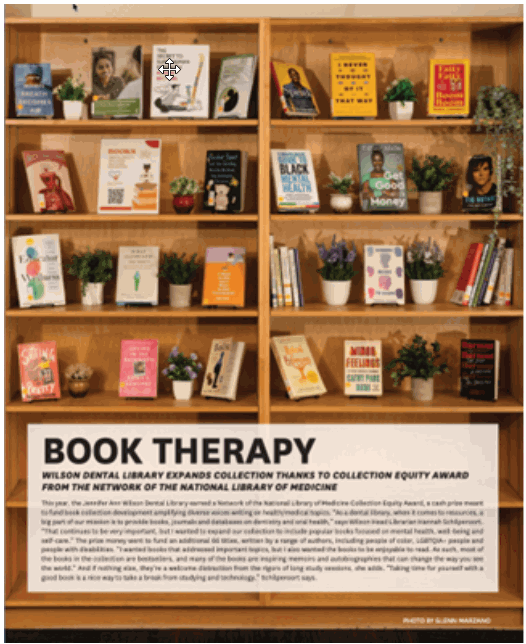
Editor�s note: This article is based on a lightning talk presented at the Medical Library Association (MLA) Conference in May 2025. Background In health sciences libraries, our mission has traditionally focused on providing access to resources that directly support curriculum, clinical practice, and research. This is true for the Wilson Dental Library, part of the USC Libraries system at the University of Southern California. USC Libraries has moved to an electronic-first acquisition model, with few exceptions for purchasing print. This approach generally meets our needs because many core dental texts are available through our online subscription packages. However, this also means that our print collections become increasingly outdated as the years pass, resulting in the need to weed collections, which leaves us with more empty shelves. I personally do not like the aesthetics of empty shelves in a library and wanted to fill some of our empty shelves with popular books. These books would be ones not typically available in a dental library that were relevant to understanding community health but also enjoyable to read. NNLM Region 5 Collection Equity Award In 2023, I applied for a Network of the National Library of Medicine (NNLM) Region 5 Collection Equity Award, which provides funding for libraries to build collections to improve health literacy and that reflect the diversity of the communities who use the library. My application emphasized that mental health and well-being are important to health sciences students in their roles as clinicians providing holistic care to patients from varying backgrounds and as students attending to their own well-being. Studies have demonstrated that oral health is part of overall health and well-being and have highlighted the need for holistic oral health approaches that address the whole person (American Dental Association Health Policy Institute, 2016; Herbert, 2023; National Institute of Dental and Craniofacial Research, 2021; Tiwari et al., 2022). Other studies have shown that dentists often suffer from burnout, exhaustion, and chronic depression (FDI World Dental Federation, 2024) and that the percentage of dentists with anxiety has significantly increased since 2003 (Burger, 2022). These reports suggest the need for dental providers to have access to information on well-being and mental health to provide the best oral care to their patients as well as to cope with their own mental health. I was awarded $1,500.00 to build a mental health and well-being collection at the Wilson Dental Library. Building and Promoting the Collection I was able to purchase 66 print books with the grant funding. I used bestseller lists and the NNLM�s Diverse Voices Collection Development Toolkit (Torp, 2022) to intentionally curate a collection for diverse audiences by diverse writers. I wanted to have a collection that had stories that resonated with a wide range of needs, identities, and perspectives. I intentionally selected books written by a wide range of authors, including women, people of color, LGBTQ+ people, and people with disabilities. Books range from inspirational memoirs to books about wellness, belonging, mindfulness, self-care, stress management, time management, healthy habits, body positivity, and financial literacy. Library staff added the books to the catalog and created a display in the library in late 2024. We have promoted the collection through the library�s website, newsletter, Instagram account, cultural heritage month book displays, and the Collection Discovery feature in our ExLibris Alma-Primo Integrated Library System (ILS). The Collection Discovery feature creates a visually appealing way to browse the collection digitally and enables sharing through a single link or QR code. The collection was featured in the Winter 2024-2025 issue of TroDent, the official alumni publication of the Herman Ostrow School of Dentistry of USC, in a brief article titled �Book Therapy� (see Figure 1).
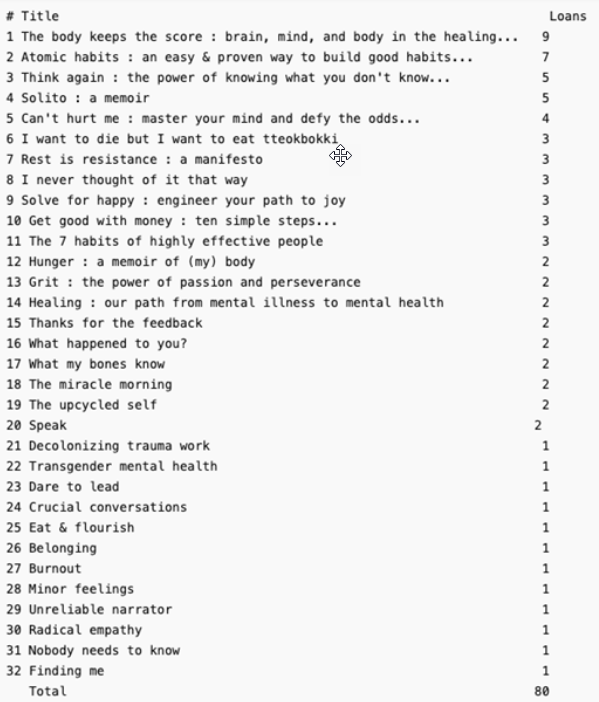
Figure 1: Brief article in winter 2024-2025 issue of TroDent. Photo by Glenn Marzano. Credit: TroDent Assessing the Collection I reviewed usage statistics to determine the most frequently borrowed books during the first two years of circulation, May 2024 through May 2026. Thirty-two of the 66 books were borrowed during this period, totaling 80 loans, ranging from 1 to 9 loans per title (see Table 1). The 32 borrowed books primarily centered on topics of self-improvement, self-actualization, productivity, emotional well-being, and interpersonal communication, reflecting intersections of mental health, personal growth, and lived experience. Primary genres included self-help, memoir/biography, and informational works. Students were the primary borrowers at 82.5%. USC Libraries does not collect statistics on which academic programs borrowers are affiliated with, but Wilson Dental Library staff interactions at the front desk suggest that this collection is utilized by the university community within and outside the dental school. Based on staff interactions, we anecdotally determined that many borrowers from across the USC community discovered books by searching the library catalog and then made their way to the Wilson Dental Library specifically to borrow a book. Interestingly, the most borrowed popular reading title circulated 4 times in fiscal year (FY) 2025 and 5 times in FY 2026, compared to 2 and 3 times, respectively, for the top circulating dental print book. However, this is not a true comparison because students and faculty are accessing dental texts primarily through our online subscriptions.
Table 1: Circulation statistics for popular books, May 2024-May2026. Table generated by USC�s ChatGPT model (OpenAI GPT-5.5 Edu). Takeaway for Health Sciences Libraries In health sciences, popular or leisure reading can support well-being and cultural awareness, both of which are relevant to students in their roles as future clinicians. The experience at the Wilson Dental Library suggests that university communities are interested in print leisure reading, which is more commonly associated with public libraries. These collections can also help fill empty shelves and make the library a more inviting space. This interest in print leisure reading presents an important counterpoint to the preference for electronic, simultaneous-access textbooks to support curricular needs in higher education and academic libraries. However, most academic libraries have limited funding for resources that are not directly tied to the curriculum. External funding opportunities, such as the NNLM Region 5 Collection Equity Award, can provide critical support for building extracurricular print collections. Health sciences librarians may wish to explore such opportunities to develop collections that support the well-being, cultural awareness, and broader development of their communities. Acknowledgements I want to thank Olivia Carreon, Wilson Dental Library (WDL) Library Supervisor, for creating an attractive physical display, and Jennifer A. Silverman, WDL Health Sciences Librarian, for helping me to promote the collection through cultural heritage month displays and Instagram. References American Dental Association Health Policy Institute. (2016). Oral health and well-being in the United States. https://www.ada.org/resources/research/health-policy-institute/coverage-access-outcomes/oral-health-and-well-being Burger, D. (2022, May 9). Association tackles mental health with sense of urgency. American Dental Association. https://www.ada.org/publications/ada-news/2022/may/association-tackles-mental-health-with-sense-of-urgency FDI World Dental Federation. (2024). Mental health and well-being for oral health professionals and dental students. International Dental Journal, 74(1), 159�160. https://doi.org/10.1016/j.identj.2023.10.005 Herbert, C. (2023). Oral health and mental health in healthy adults, a topic of primary prevention and health care, empirical results from two online studies. Current Psychology, 42(36), 32110�32124. https://doi.org/10.1007/s12144-022-04121-8 National Institute of Dental and Craniofacial Research. (2021). Oral health in America: Advances and challenges. U.S. Department of Health and Human Services, National Institutes of Health. https://www.nidcr.nih.gov/research/oralhealthinamerica Tiwari, T., Kelly, A., Randall, C. L., Tranby, E., & Franstve-Hawley, J. (2022). Association between mental health and oral health status and care utilization. Frontiers in Oral Health, 2, 732882. https://doi.org/10.3389/froh.2021.732882 Torp, K. (2022, September 28). Announcing the diverse voices in health & medicine collection development toolkit. https://news.nnlm.gov/region_5/announcing-the-diverse-voices-in-health-medicine-collection-development-toolkit/ DCT Featured Article � October 13, 2026 |
||
| Copyright 2014 - Doody Enterprises, Inc. - All rights reserved |