|
|
|
eBook/Digital Version available from:
|
 Score: 96 |
 |
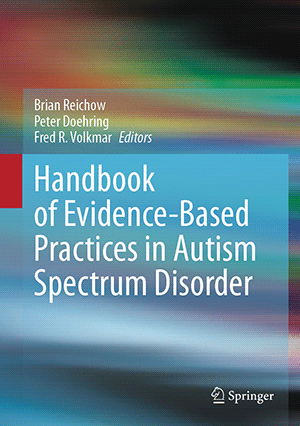
| Handbook of Evidence-Based Practices in Autism Spectrum Disorder |
|
ISBN: 978-3031781421,
537 pages,
Hard Cover
ISBN-10: 3031781422 |
|
| Copyright: |
2025 |
|
| Edition: |
1st |
|
| Editor: |
Reichow, Brian, PhD; Doehring, Peter, PhD; Volkmar, Fred R., MD |
|
|
Specialties:
|
Psychology, Clinical |
|
| Publisher: |
Springer |
|
| List Price: |
$299.99 |
|
| Google: |
|
|
|
|
|
|
|
At A Glance
|
The handbook examines the empirical status of interventions and treatments for individuals with autism spectrum disorder (ASD). It offers an insightful and balanced perspective on topics ranging from the historical underpinnings of autism treatment to the use of psychopharmacology and the implementation of EBPs. The book reviews the conceptualization of evidence-based practices (EBPs) as well as considerations for implementing such practices across settings. In addition, it describes emerging treatments - though they cannot yet be considered evidence-based - that have produced limited but highly promising results. The book also describes treatments and therapies that have been proved ineffective. It explores ways in which EBPs can be applied in inclusive school settings, pediatric settings, in-patient treatment programs, and college-based programs for transition-aged youth. The volume describes outcomes from the development of EBP guidelines at the national level (in Scotland) and, more broadly, in the United States and outlines how such guidelines can be adapted to offer more individualized intervention. Case descriptions are used to support, facilitate, and refine the learner?s deductive clinical reasoning skills. Learn more and order here.
|
|
Reviewer:
|
Gary Kaniuk,
PsyD
(Cermak Health Services)
|
|
|
Range
|
Question
|
Score
|
| 1-10 |
Are the author's objectives met? |
10 |
| 1-10 |
Rate the worthiness of those objectives. |
10 |
| 1-5 |
Is this written at an appropriate level? |
5 |
| 1-5 |
Is there significant duplication? (1=significant, 5=insignificant) |
5 |
| 1-5 |
Are there significant omissions? (1=significant, 5=insignificant) |
5 |
| 1-5 |
Rate the authority of the authors. |
5 |
| 1-5 |
Are there sufficient illustrations? |
5 |
| 1-5 |
Rate the pedagogic value of the illustrations. |
5 |
| 1-5 |
Rate the print quality of the illustrations. |
4 |
| 1-5 |
Are there sufficient references? |
5 |
| 1-5 |
Rate the currency of the references. |
5 |
| 1-5 |
Rate the pertinence of the references. |
5 |
| 1-5 |
Rate the helpfulness of the index. |
3 |
| 1-5 |
If important in this specialty, rate the physical appearance of the book |
N/A |
| 1-10 |
Is this a worthwhile contribution to the field? |
10 |
| 1-10 |
If this is a 2nd or later edition, is this new edition needed? |
N/A |
|
|
|
Reviewer:
|
Gary Kaniuk,
PsyD
(Cermak Health Services)
|
|
|
Description
|
| This handbook considers different interventions to help individuals diagnosed with autism spectrum disorder (ASD). It discusses specific evidence-based programs, evidence-based practices, and future directions for children with ASD. It also provides guidelines to help tailor individualized treatments. |
|
|
Purpose
|
| The book focuses on research underlying the different treatments available for individuals with autism spectrum disorder. It reviews the history of autism treatment and current evidence-based interventions, along with new modalities that are being tested. The book also describes treatments that have been shown to be ineffective. Those are worthy objectives and the book meets them. |
|
|
Audience
|
| The book is intended for researchers, graduate students, clinicians, and all professionals working with children in various settings, especially those interested in autism spectrum disorder. The book meets the needs of its intended audience. The authors are credible authorities in the subject matter. Brian Reichow is associate director of research at the University of Connecticut. His research interests include young children at risk for developmental disabilities. Peter Doehring is an independent researcher and advocate for children with severe disabilities and their parents and guardians. Fred R. Volkmar is on the faculty of Southern Connecticut State University. He is a renowned authority on Asperger's disorder and autism spectrum disorder and has published extensively in the field. The other contributors represent an international authorship affiliated with well-known institutions of higher learning and treatment facilities. |
|
|
Features
|
| The book includes 22 chapters and begins with an introduction to the history of autism research, which can be traced back to the early 1940s. The emphasis then was on seeing the problem as psychological as opposed to biological. Evidence-based practices began to surface in the late 1990s. Interventions focus on cognition, language, adaptive behavior, and social behavior. The Early Start Denver Model has an evidence base of positive results with early intervention. Behavioral models focus on reducing problematic behavior with appropriate replacement behavior. Cognitive behavioral therapy (CBT) programs need greater research foundation. Psychopharmacological approaches have mixed results. It is important to consider alternative treatments such as vitamins, neurofeedback devices, computer games, music therapy, and exercise and movement. Since children with disabilities are eligible for education between the ages of 3 and 21, there must be evidence-based approaches utilized within a multi-disciplinary framework. The book concludes with an emphasis on the need for more research on evidence-based practices, especially since many more children are being diagnosed with autism spectrum disorder and the cost of lifetime care now exceeds three million dollars. The book is highly readable and contains numerous tables that help clarify the text. |
|
|
Assessment
|
| This excellent handbook covers so much ground. It describes many different evidence-based practices for readers to get a sense of what is effective and what is not. It presents cutting-edge research information that cannot easily be found elsewhere. I definitely recommend this book. |
|
|
|
|
|
|
|
|