|
|
|
eBook/Digital Version available from:
|
 Score: 85 |
 |
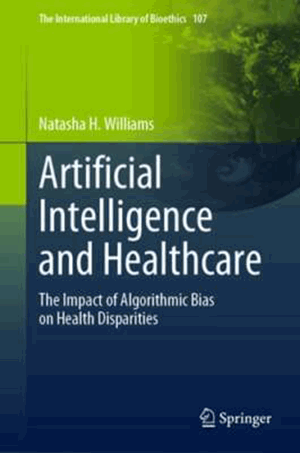
| Artificial Intelligence and Healthcare: The Impact of Algorithmic Bias on Health Disparities |
|
ISBN: 978-3031482618,
114 pages,
Hard Cover
Volume: 107
ISBN-10: 3031482611 |
|
| Copyright: |
2023 |
|
| Edition: |
1st |
|
| Author: |
Williams, Natasha H. |
|
|
Specialties:
|
Health Equity, Diversity & Inclusion
, Medical Ethics
, Medical Informatics |
|
| Publisher: |
Springer |
|
| Series Title: |
The International Library of Bioethics |
|
| List Price: |
$119.99 |
|
| Google: |
|
|
|
|
|
|
|
Reviewer:
|
Chad Quilling,
BS
(Rocky Vista University College of Osteopathic Medicine)
|
|
|
Range
|
Question
|
Score
|
| 1-10 |
Are the author's objectives met? |
10 |
| 1-10 |
Rate the worthiness of those objectives. |
8 |
| 1-5 |
Is this written at an appropriate level? |
5 |
| 1-5 |
Is there significant duplication? (1=significant, 5=insignificant) |
4 |
| 1-5 |
Are there significant omissions? (1=significant, 5=insignificant) |
4 |
| 1-5 |
Rate the authority of the authors. |
5 |
| 1-5 |
Are there sufficient illustrations? |
5 |
| 1-5 |
Rate the pedagogic value of the illustrations. |
3 |
| 1-5 |
Rate the print quality of the illustrations. |
5 |
| 1-5 |
Are there sufficient references? |
3 |
| 1-5 |
Rate the currency of the references. |
5 |
| 1-5 |
Rate the pertinence of the references. |
4 |
| 1-5 |
Rate the helpfulness of the index. |
3 |
| 1-5 |
If important in this specialty, rate the physical appearance of the book |
N/A |
| 1-10 |
Is this a worthwhile contribution to the field? |
8 |
| 1-10 |
If this is a 2nd or later edition, is this new edition needed? |
N/A |
|
|
|
Reviewer:
|
Chad Quilling,
BS
(Rocky Vista University College of Osteopathic Medicine)
|
|
|
Description
|
| This book describes artificial intelligence (AI), including diverse ways it can be created and how it is currently being utilized in healthcare. It then discusses ways bias can be introduced into AI and problems that can occur from that resulting bias. The book further investigates current and former problems affecting healthcare, including healthcare disparities, racial and ethnic bias in studies, and implicit bias. It concludes with current and future recommendations about how AI systems are developed and governed to avoid reproducing these disparities and biases. The book includes tables to make referencing these recommendations simpler and some graphics to summarize various content. The book is part of The International Library of Bioethics series. |
|
|
Purpose
|
| The purpose of this book is to discuss the use of artificial intelligence in healthcare and how it can potentially solve current and historical problems the healthcare system is experiencing. In addition, it aims to discuss potential pitfalls surrounding AI and how AI developers and policy makers can create a system to avoid such pitfalls. With the healthcare system facing work shortages and also wanting to find ways to benefit patients and physicians, AI could benefit the healthcare system. However, an understanding of previous pitfalls that healthcare has faced and how the system can avoid these pitfalls in the future if AI were implemented should be understood, otherwise, those mistakes could be repeated. The book does an effective job of helping build an acquaintance with these topics and offers enough information to move forward in whatever direction healthcare systems choose to go, be it AI creation, implementation, or policy creation. |
|
|
Audience
|
| According to the book's summary, its audience includes almost all relevant fields that intersect with AI and healthcare, including "health services researchers, ethicists, policy analysts, social scientists, health disparities researchers, and AI policy makers." Because of the wide audience the book is trying to reach, there will be gaps somewhere in their knowledge of the subjects explored. The book can fill these gaps in the realm of healthcare, artificial intelligence, and research ethics. In addition, it does show the risks and benefits of using AI in the healthcare setting and how to avoid pitfalls the audience may have previously fallen into. The author, the current chief of Legislation and Public Policy in the Office of Legislation, Public Policy, and Ethics at the NIH, a former legislative liaison at the National Institute on Minority Health and Health Disparities at the NIH, and a bachelor's degree in medical technology, has a unique background necessary to discuss all of these topics with credibility in addition to her numerous citations found in this book. |
|
|
Features
|
| The book effectively creates a great starting point for anyone interested in AI use in healthcare and the ethics surrounding it. Starting with a basic discussion of what AI is, how it is created, what is used in its creation, and how curating such data can result in ethical problems, the book leads into a further discussion of more general healthcare ethics. Such ethics discussed include health disparities, racial bias, and ethnic bias, including specific historical examples that still create ripples today. Such examples were chosen to both bring up the most known examples to fill possible gaps and to later addresses these potential issues that can be solved by AI. Subsequently, the book discusses other current problems regarding AI research, such as replication, and offers potential solutions. This warns healthcare workers about potential downfalls of AI when blindly followed, while helping current AI researchers find ways to solve current problems. Finally, the book discusses current policy surrounding AI, helping those interested in being advocates for policy decisions to understand the basics surrounding the current state of such policy. The book includes an index in addition to a well-structured table of contents. Tables with some of the most actionable information are included that stand out from the rest of the book. Each chapter also includes an abstract and summary section, allowing readers to quickly glean information before spending the time to read each chapter. In addition, the end of each chapter includes reference sections to separate out resources. Some chapters are difficult to read due to the considerable number of citations present and the length of some in-text citations (some spanning multiple lines). In addition, some numbered lists could be better formatted to make it easier to distinguish specific points. However, when it comes to content, there does not appear to be any relevant information that is not discussed somewhere. |
|
|
Assessment
|
| This book is an effective starting place for anyone interested in getting started in learning about AI's use in healthcare. It is effective at teaching the basics concerning AI, its creation, possible ethical pitfalls in its use, and current policy surrounding it both in the United States and the European Union. Further, it uses the most up-to-date information at the time it was written. While some changes have occurred since its publication (such as Google Bard now being named Gemini), the basic foundations it teaches and the history it gives on healthcare, make it useful to its audience. In addition, while there are some other books and papers that address similar ideas, this book is effective in creating a one-stop for anyone to investigate AI use in healthcare while considering the ethical considerations surrounding it. |
|
|
|
|
|
|
|
|