|
|
|
eBook/Digital Version available from:
|
 Score: 91
 |
 |
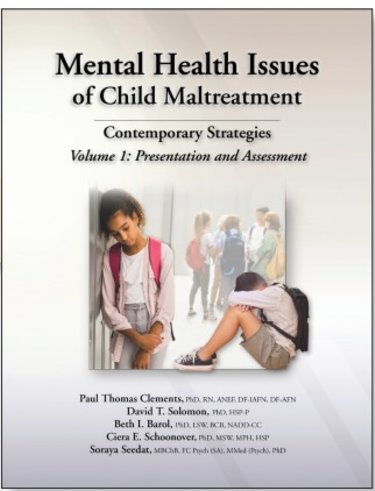
| Mental Health Issues of Child Maltreatment: Contemporary Strategies, Volume 1: Presentation and Assessment |
|
ISBN: 978-1-953119-20-9,
137 pages,
Soft Cover
ISBN-10: 1-953119-20-4 |
|
| Copyright: |
2024 |
|
| Edition: |
1st |
|
| Author: |
Clements, Paul Thomas, PhD, RN, ANEF, DF-IAFN, DF-AFN; Solomon, David T., PhD, HSP-P; Barol, Beth I., PhD, LSW, BCB, NADD-CC; Schoonover, Ciera E., PhD, MSW, MPH, HSP; Seedat, Soraya, PhD, MBChB, FC Psych, MMed Psych, MPhil |
|
|
Specialties:
|
Psychology, Clinical
, Pediatrics
, Psychiatry
, Pediatrics
, Psychiatric |
|
| Publisher: |
STM Learning, Inc. formerly GW Medical Publishing |
|
| List Price: |
$100.00 |
|
| Google: |
|
|
|
|
|
|
|
At A Glance
|
The fi rst volume of Mental Health Issues of Child Maltreatment: Contemporary Strategies is a thorough examination of current knowledge on the way child abuse and neglect can affect a child's mental and emotional development.In this volume, inderdisciplinary professionals focus on the presentation and assessment of trauma with a special focus on post-pandemic emerging trends in diagnosis.
|
|
Reviewer:
|
Joseph Hageman,
MD
(Touro University Illinois)
|
|
|
Range
|
Question
|
Score
|
| 1-10 |
Are the author's objectives met? |
10 |
| 1-10 |
Rate the worthiness of those objectives. |
10 |
| 1-5 |
Is this written at an appropriate level? |
5 |
| 1-5 |
Is there significant duplication? (1=significant, 5=insignificant) |
3 |
| 1-5 |
Are there significant omissions? (1=significant, 5=insignificant) |
4 |
| 1-5 |
Rate the authority of the authors. |
5 |
| 1-5 |
Are there sufficient illustrations? |
3 |
| 1-5 |
Rate the pedagogic value of the illustrations. |
4 |
| 1-5 |
Rate the print quality of the illustrations. |
5 |
| 1-5 |
Are there sufficient references? |
5 |
| 1-5 |
Rate the currency of the references. |
4 |
| 1-5 |
Rate the pertinence of the references. |
5 |
| 1-5 |
Rate the helpfulness of the index. |
4 |
| 1-5 |
If important in this specialty, rate the physical appearance of the book |
N/A |
| 1-10 |
Is this a worthwhile contribution to the field? |
10 |
| 1-10 |
If this is a 2nd or later edition, is this new edition needed? |
N/A |
|
|
|
Reviewer:
|
Joseph Hageman,
MD
(Touro University Illinois)
|
|
|
Description
|
| This is a detailed, two-volume, dense, intricate, well-written summary for front-line professionals who care for and protect children. |
|
|
Purpose
|
| The purpose is to educate front-line professionals, including clinicians, social workers, therapists, teachers, nurses, child protection workers, criminal justice professionals, and medical and mental health providers who are involved with dealing with the mental health issues of child maltreatment. The objectives are worthy, and this book is essential and needed. |
|
|
Audience
|
| The book's audience is the front-line professionals listed in the previous paragraph who are involved with caring for, teaching, and protecting children who may experience adverse childhood experiences (ACEs). This detailed summary educates all of those who are involved in various aspects of child maltreatment and its effects on these children and their families. The book meets the needs of the intended audience. The authors are credible authorities with extensive clinical experience in this area. |
|
|
Features
|
| This book, volume one of two, provides a detailed, multifaceted approach to the recognition of the clinical presentations, effects on children's biological, physical, mental, and emotional states, and long-term effects of these ACEs. The book's presentation begins with child abuse and the emergence and impact of trauma, including developmental, single-incident trauma, and post-traumatic stress disorder. It then progresses with evaluation and recognition, including clinical interviewing and assessment strategies. |
|
|
Assessment
|
| This book presents a valuable, current approach for all of those who are involved with the evaluation, assessment, and management of children who have experienced adverse childhood experiences. It is detailed, somewhat dense, and requires time and concentration to absorb the clinically important information presented in this area. The book's Foreword also includes the fact that there has been a decline in child abuse. The reason is the dramatic improvement of education of all providers involved in the evaluation, care, and further management of children who have experienced abuse or ACEs. Because of this, the hope is that the long term developmental, psychological, and psychiatric outcomes of these patients will be much improved. Having had the clinical experience of caring for children and adolescents who have been abused and experienced over a period of 30 years in the intensive care unit, in the emergency department, on the pediatric floor, I welcome this two volume book as a valuable educational resource for all of us who are involved in their care. |
|
|
|
|
|
|
|
|