|
|
|
eBook/Digital Version available from:
|
 Score: 88
 |
 |
| Greenfield's Neuropathology - 2 Volume Set, 10th Edition |
|
|
Doody's Core Title (2026 Edition)
|
|
| Score(s): |
|
2.33
(Health Sciences - Pathology)
|
|
|
ISBN: 978-0-367-89508-2,
2292 pages,
Hard Cover
ISBN-10: 0-367-89508-0 |
|
| Copyright: |
2025 |
|
| Edition: |
10th |
|
| Editor: |
Smith, Colin; Perry, Arie; Kovacs, Gabor; Jacques, Thomas |
|
|
Specialties:
|
Pathology
, Neurology |
|
| Publisher: |
CRC Press/Taylor & Francis Group |
|
| List Price: |
$520.00 |
|
| Google: |
|
|
|
|
|
|
|
At A Glance
|
Greenfield's is the world?s leading neuropathology reference. It provides a comprehensive account of the pathological findings in neurological disease, their biological basis, and their clinical manifestations. The two volume work provides a remarkable text which is clear, comprehensive and precise with exceptional illustrations. The tenth edition features fully updated sections covering CNS tumours, neurodegeneration, skeletal muscle, epilepsy, paediatric and forensic neuropathology. Expert coverage from an international team of Editors and contributors ensures authoritative and up to date content. The two volume set includes a downloadable and easily used e-version. This is a tried and tested reference for scientists, clinicians, researchers, and students who wish to learn more about neurological disease.
|
|
Reviewer:
|
Ryan Landvater,
MD, MEng
(University of Michigan Medical School)
|
|
|
Range
|
Question
|
Score
|
| 1-10 |
Are the author's objectives met? |
8 |
| 1-10 |
Rate the worthiness of those objectives. |
10 |
| 1-5 |
Is this written at an appropriate level? |
5 |
| 1-5 |
Is there significant duplication? (1=significant, 5=insignificant) |
4 |
| 1-5 |
Are there significant omissions? (1=significant, 5=insignificant) |
5 |
| 1-5 |
Rate the authority of the authors. |
5 |
| 1-5 |
Are there sufficient illustrations? |
5 |
| 1-5 |
Rate the pedagogic value of the illustrations. |
5 |
| 1-5 |
Rate the print quality of the illustrations. |
2 |
| 1-5 |
Are there sufficient references? |
5 |
| 1-5 |
Rate the currency of the references. |
4 |
| 1-5 |
Rate the pertinence of the references. |
5 |
| 1-5 |
Rate the helpfulness of the index. |
3 |
| 1-5 |
If important in this specialty, rate the physical appearance of the book |
N/A |
| 1-10 |
Is this a worthwhile contribution to the field? |
8 |
| 1-10 |
If this is a 2nd or later edition, is this new edition needed? |
10 |
|
|
|
Reviewer:
|
Ryan Landvater,
MD, MEng
(University of Michigan Medical School)
|
|
|
Description
|
| This authoritative neuropathology reference is now in its tenth edition, incorporating advancements in molecular diagnostic techniques that define the bleeding edge of diagnostic neuropathology. This edition effectively blends contemporary techniques with established histopathologic and chemical diagnostics that form the bedrock of the modern neuropathology practice. The previous ninth edition was published in 2015. |
|
|
Purpose
|
| This title remains the authoritative reference for the discipline of neuropathology. This tenth edition improves the reference nature of the books by introducing broad sections at the highest level of organization with shorter but more numerous directed chapters within each section. This is effective in making the volumes easier to navigate. |
|
|
Audience
|
| Academic research institutions, especially those with contemporary molecular diagnostic laboratories, should strongly consider investing in this newest edition due to this version's incorporating of epigenetic tools in neuropathology diagnosis, both neoplastic and non-neoplastic, and for the references to the most contemporary literature. Diagnostic neuropathologists may similarly find value both in the restructuring of the basic neuropathologic reference and as a single consolidated resource that covers the breath of our evolving diagnostic criteria. This edition was chiefly edited by Dr. Colin Smith, a shift from Dr. Seth Love in previous recent editions. |
|
|
Features
|
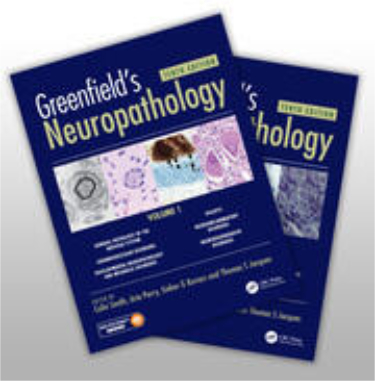
| This edition contains two volumes, as did previous editions. The number of chapters expanded from the previous 46 to 62 chapters, while only extending the page count by about 162 pages. The result is a concise restructuring of content that incorporates evolving diagnostic tools (such as semi-supervised epigenetic / methylation classifiers) and advancements in basic science models underlying the pathogenesis of degenerative processes. Approximately 30% (overall) of cited primary research was published since the previous edition. Previous materials, including histologic frames and illustrative diagrams, have been reordered into shorter, more directed chapters for ease of reference. The print quality of this edition is diminished from previous editions with less glossy and durable paper and reduced overall print quality. This reduced print quality affects histologic image clarity with many images appearing noisy; however, the digital editions, which are freely available with the purchase of a physical copy, have appropriately crisp images. Histology image white balance and exposure can be quite variable but is on-par with prior editions. An ePublication is available through VitalSource on purchase of the physical volumes or may be purchased without the physical volumes. A PDF virtual edition is also available from the Taylor and Francis publishing group for institutions with access. This ePublication is identical to the print edition but does not allow the reader to resize text (which may make reading difficult for some due to the small print) or allow the reader to change the background coloring to reduce eyestrain. The figure quality is improved relative to the print quality, and most images show crisp detail. The overall ePublication quality is excellent with the caveat that a true ePublication with adjustable font size would improve readability. |
|
|
Assessment
|
| This book remains the authoritative neuropathology reference. Dr. Colin Smith, the full editorial board, and numerous world-expert authors have improved the overall structuring of the work by very effectively restructuring the volumes for improved reference and by incorporating a vast amount of contemporary literature without expanding the size. |
|
|
|
|
|
|
|
|