|
|
|
eBook/Digital Version available from:
|
 Score: 91
 |
 |
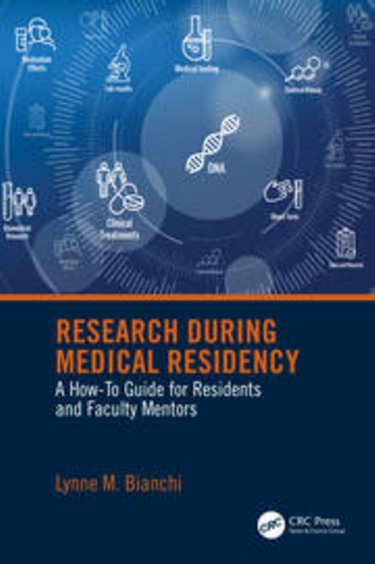
| Research During Medical Residency: A How-To Guide for Residents and Faculty Mentors |
|
|
Doody's Core Title (2026 Edition)
|
|
| Score(s): |
|
2.6
(Health Sciences - Medical Education)
Essential Purchase Title
|
|
|
ISBN: 978-0-367-64830-5,
305 pages,
Soft Cover
ISBN-10: 0-367-64830-X |
|
| Copyright: |
2022 |
|
| Edition: |
1st |
|
| Author: |
Bianchi, Lynne M., PhD |
|
|
Specialties:
|
Medical Education & Informatics |
|
| Publisher: |
CRC Press/Taylor & Francis Group |
|
| List Price: |
$44.99 |
|
| Google: |
|
|
|
|
|
|
|
At A Glance
|
A practicalguide for medical residents and faculty in the fundamentals of clinical research, publication practices, and conference skills.This bookoffers advice on how to incorporate scholarly activities into training routines.
|
|
Reviewer:
|
Victoria Maxon,
DO
(Johns Hopkins University School of Medicine)
|
|
|
Range
|
Question
|
Score
|
| 1-10 |
Are the author's objectives met? |
10 |
| 1-10 |
Rate the worthiness of those objectives. |
10 |
| 1-5 |
Is this written at an appropriate level? |
5 |
| 1-5 |
Is there significant duplication? (1=significant, 5=insignificant) |
4 |
| 1-5 |
Are there significant omissions? (1=significant, 5=insignificant) |
5 |
| 1-5 |
Rate the authority of the authors. |
4 |
| 1-5 |
Are there sufficient illustrations? |
N/A |
| 1-5 |
Rate the pedagogic value of the illustrations. |
N/A |
| 1-5 |
Rate the print quality of the illustrations. |
N/A |
| 1-5 |
Are there sufficient references? |
5 |
| 1-5 |
Rate the currency of the references. |
3 |
| 1-5 |
Rate the pertinence of the references. |
5 |
| 1-5 |
Rate the helpfulness of the index. |
3 |
| 1-5 |
If important in this specialty, rate the physical appearance of the book |
N/A |
| 1-10 |
Is this a worthwhile contribution to the field? |
10 |
| 1-10 |
If this is a 2nd or later edition, is this new edition needed? |
N/A |
|
|
|
Reviewer:
|
Victoria Maxon,
DO
(Johns Hopkins University School of Medicine)
|
|
|
Description
|
| This book is a step-by-step guide on how to start, integrate, and create meaningful research. It includes advice and structure for grant writing, presentations, journal articles, and book chapters. |
|
|
Purpose
|
| The book's purpose is to create a how-to guide for performing research during medical residency. This book is of value because many students, residents, or even faculty may have little prior experience with research, and this book breaks down the sometimes intimidating terminology and process into simpler steps. The book meets the objective and creates a more approachable plan to starting and creating quality research. |
|
|
Audience
|
| The book is written for faculty and medical residents, but the tips and tricks are applicable to all specialties and any clinician interested in pursuing research. The book clearly meets the needs of the intended audience. The author is a recognized expert in medical research and education. Each chapter also has input from authors from a wide array of specialties. |
|
|
Features
|
| This book addresses every step of the research project from idea inception and trial design to funding and publication. The best instruction the book provides is how to style cover letters, grant proposals, and publications to fit the objectives of each specific organization. Each section is well organized with the most important points bolded as well as highlighted statements of tips, hints, and notes. The chapter titles are very informative. It would be useful to include tips on how to negotiate protected research time and advocate for funding for students, residents, and faculty to attend conferences. |
|
|
Assessment
|
| The book is an appropriate starting point for someone who is completely new to medical research or has little experience. It provides a broad overview of the process from idea inception to completion. Other books on the market focus specifically on medical writing or designing clinical trials. The book is unique in the details it provides regarding preparing posters and presentations. |
|
|
|
|
|
|
|
|