|
|
|
eBook/Digital Version available from:
|
 Score: 95 |
 |
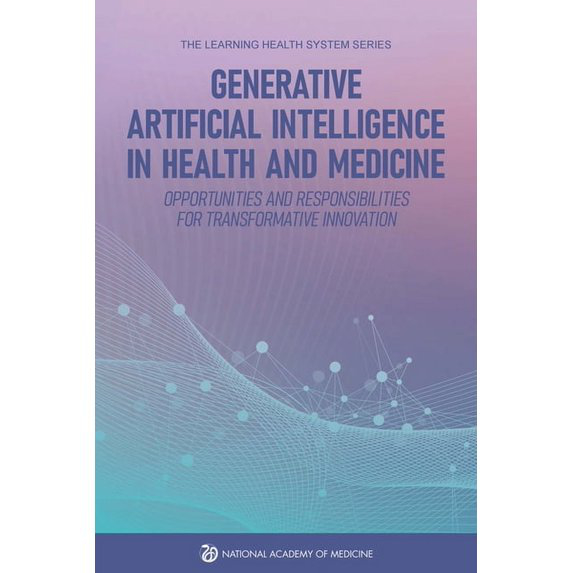
| Generative Artificial Intelligence in Health and Medicine: Opportunities and Responsibilities for Transformative Innovation |
|
|
Doody's Core Title (2026 Edition)
|
|
| Score(s): |
|
2.47
(Health Sciences - Medical Informatics)
|
|
|
ISBN: 978-0-309-73369-4,
51 pages,
Soft Cover
ISBN-10: 0-309-73369-3 |
|
| Copyright: |
2025 |
|
| Edition: |
1st |
|
| Author: |
National Academy of Medicine |
|
|
Specialties:
|
General Internal Medicine
, Primary Care
, Medical Informatics |
|
| Publisher: |
National Academy of Medicine |
|
| Series Title: |
The Learning Health Systems Series |
|
| List Price: |
$22.00 |
|
| Google: |
|
|
|
|
|
|
|
At A Glance
|
The integration of large language models (LLMs) and generative artificial intelligence (AI) in health care holds the potential to transform the practice of medicine, the work and experiences of health care providers, and the health and well-being of patients. Generative AI can support clinical decision making and streamline workflows, promote patients and their support networks' engagement in care processes, and support clinical research. However, successful and ethical implementation of generative AI requires careful consideration of the associated risks, particularly those concerning data privacy, bias, transparency, and infrastructure limitations. Generative Artificial Intelligence in Health and Medicine: Opportunities and Responsibilities for Transformative Innovation explores the transformative potential of generative AI in health care, with a focus on its applications in clinical decision making, administrative efficiency, and patient engagement.
|
|
Reviewer:
|
Aaron Saguil,
MD, MPH, FAAFP
(University of Florida College of Medicine)
|
|
|
Range
|
Question
|
Score
|
| 1-10 |
Are the author's objectives met? |
10 |
| 1-10 |
Rate the worthiness of those objectives. |
10 |
| 1-5 |
Is this written at an appropriate level? |
5 |
| 1-5 |
Is there significant duplication? (1=significant, 5=insignificant) |
4 |
| 1-5 |
Are there significant omissions? (1=significant, 5=insignificant) |
4 |
| 1-5 |
Rate the authority of the authors. |
5 |
| 1-5 |
Are there sufficient illustrations? |
5 |
| 1-5 |
Rate the pedagogic value of the illustrations. |
5 |
| 1-5 |
Rate the print quality of the illustrations. |
3 |
| 1-5 |
Are there sufficient references? |
5 |
| 1-5 |
Rate the currency of the references. |
5 |
| 1-5 |
Rate the pertinence of the references. |
5 |
| 1-5 |
Rate the helpfulness of the index. |
N/A |
| 1-5 |
If important in this specialty, rate the physical appearance of the book |
N/A |
| 1-10 |
Is this a worthwhile contribution to the field? |
10 |
| 1-10 |
If this is a 2nd or later edition, is this new edition needed? |
N/A |
|
|
|
Reviewer:
|
Aaron Saguil,
MD, MPH, FAAFP
(University of Florida College of Medicine)
|
|
|
Description
|
| This book takes as its primary topic the opportunities for integrating evolving generative artificial intelligence technology in health care and the potential harm that may accompany it. It reviews the current state of generative artificial intelligence integration in medicine, both actual and perceived risks, and a proposed pathway for the conception, design, evaluation, use, and regulation of future generative artificial intelligence tools in health care. |
|
|
Purpose
|
| The book's purpose is to discuss the "safe, effective, ethical, and equitable" implementation of generative artificial intelligence in health care while also minimizing the risks of doing so. This purpose sits within the context of the learning health system in which health entities strive for continuous improvement and the parallel context of shared commitments to ensure systems are accessible and accountable. This book achieves its purpose with a timely discussion of the technology that has already, and will continue to, transform the delivery of health care. |
|
|
Audience
|
| This book is written with multiple stakeholders in mind, to include healthcare professionals, generative artificial intelligence developers, patients and communities, policymakers, and researchers. Indeed, the authors include experts in technology, artificial intelligence, clinicians, non-profits, government, and industry. It is agnostic to specialty, recognizing how generative artificial intelligence is having an impact across specialty delineations. The book will benefit anyone interested in how best to pursue new generative artificial intelligence technologies and how to ensure the equitable development, deployment, and regulation of such technologies. |
|
|
Features
|
| This book provides an overview of what generative artificial intelligence is and some of its current and proposed use cases in medicine. It then discusses some of the risks of applying generative artificial intelligence models to medicine, including risks of bias, of hallucinations, and of models deteriorating after time. It concludes with a framework by which key stakeholders, such as healthcare professionals, generative artificial intelligence developers, patients, policymakers, and researchers can collaborate on the conceptualization, creation, testing, deployment, and maintenance of new generative artificial intelligence models and technologies. The writing is clear, and each of its several chapters can be read either in isolation or as part of the whole. Helpful charts show how generative artificial intelligence compares with the more limited predictive models that preceded its deployment and how different stakeholders can collaborate across the generative artificial intelligence technology life cycle. |
|
|
Assessment
|
| This book is a very helpful and needed entry on the medical use of generative artificial intelligence. As opposed to a wide canvas of current use cases of generative artificial intelligence -- such as those found in books written by Eric Topol -- this book discusses a much-needed framework for approaching the creation and deployment of new technologies in a way that is both effective and equitable. It nicely summarizes some of the currents contained within the hundreds of manuscripts that have been written on this topic, which readers can then consult for additional information and discussions. This book is recommended for those engaged in the use, development, and regulation of generative artificial intelligence in medicine. |
|
|
|
|
|
|
|
|