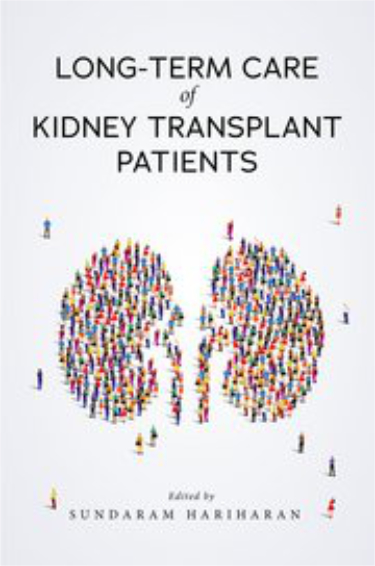
|
|
|
eBook/Digital Version available from:
|
 Score: 96
 |
 |
| Long-term Care of Kidney Transplant Patients |
|
|
Doody's Core Title (2026 Edition)
|
|
| Score(s): |
|
2.33
(Health Sciences - Nephrology)
|
|
|
ISBN: 978-0-19-769732-0,
333 pages,
Soft Cover
ISBN-10: 0-19-769732-1 |
|
| Copyright: |
2024 |
|
| Edition: |
1st |
|
| Editor: |
Hariharan, Sundaram, MD |
|
|
Specialties:
|
Nephrology
, Transplantation Surgery |
|
| Publisher: |
Oxford University Press |
|
| List Price: |
$75.00 |
|
| Google: |
|
|
|
|
|
|
|
At A Glance
|
Long-Term Care of Kidney Transplant Patients provides details on topics relevant to kidney transplant including current survival rates, phases following kidney transplantation, transplant wellness, current immunosuppressive management, and alloimmune injuries such as early and late T-cell- and antibody-mediated rejections. Various nonalloimmune factors such as post-transplant infections, cardiovascular diseases, and cancers are discussed in special chapters. Chapters are dedicated to psychological and social factors influencing kidney transplant, followed by special chapters on pediatric kidney transplantation and multiorgan transplantation. The final chapter addresses transplant tolerance, and the conclusion summarizes all chapters and highlights potential novel advances that might become game changers in the kidney transplant field. This comprehensive book is a valuable resource for clinical transplant physicians and surgeons, nephrologists, primary care physicians, as well as other healthcare specialists involved in the care of kidney transplant patients such as cardiologists and critical care physicians. It also benefits other healthcare providers such as pharmacists, psychologists, advanced nurse practitioners, pharmaceutical and diagnostic companies, and agencies involved in kidney transplantation.
|
|
Reviewer:
|
Sam Beavin,
MD
(University of Kentucky College of Medicine)
|
|
|
Range
|
Question
|
Score
|
| 1-10 |
Are the author's objectives met? |
10 |
| 1-10 |
Rate the worthiness of those objectives. |
10 |
| 1-5 |
Is this written at an appropriate level? |
5 |
| 1-5 |
Is there significant duplication? (1=significant, 5=insignificant) |
4 |
| 1-5 |
Are there significant omissions? (1=significant, 5=insignificant) |
5 |
| 1-5 |
Rate the authority of the authors. |
5 |
| 1-5 |
Are there sufficient illustrations? |
5 |
| 1-5 |
Rate the pedagogic value of the illustrations. |
4 |
| 1-5 |
Rate the print quality of the illustrations. |
4 |
| 1-5 |
Are there sufficient references? |
5 |
| 1-5 |
Rate the currency of the references. |
5 |
| 1-5 |
Rate the pertinence of the references. |
5 |
| 1-5 |
Rate the helpfulness of the index. |
5 |
| 1-5 |
If important in this specialty, rate the physical appearance of the book |
N/A |
| 1-10 |
Is this a worthwhile contribution to the field? |
10 |
| 1-10 |
If this is a 2nd or later edition, is this new edition needed? |
N/A |
|
|
|
Reviewer:
|
Sam Beavin,
MD
(University of Kentucky College of Medicine)
|
|
|
Description
|
| This book is an excellent overview of post-transplant medicine, with 19 chapters covering basic science, clinical practice, and patient-centered care. |
|
|
Purpose
|
| This book is a practical guide to the many nuances of caring for transplant patients. The book's editor has over 40 years of experience in the field, and this book also serves as an overview of the incredible advances seen during that time. |
|
|
Audience
|
| The thorough chapters and breadth of topics covered will make this an excellent resource for anyone specializing in, or hoping to specialize in, transplant medicine, including surgeons and physicians, and that is certainly the primary intended audience. However, it would also serve as a useful resource to consult for any practitioner encountering transplant patients, such as general practitioners, hospitalists, or rotating students. |
|
|
Features
|
| The chapters, each around 15-20 pages, cover a range of topics from basic transplant science (such as mechanisms of rejection and immunosuppressive medications) to patient-centered topics like "Wellness after Transplant" or psychosocial functioning. The diagrams of immune signaling and other basic science topics are well-designed and easy to follow, and the chapters almost universally include helpful reference tables. The book also has a thorough list of abbreviations in the front matter, as well as an easy to navigate index. |
|
|
Assessment
|
| Transplant medicine is perhaps the most complex, nuanced field within nephrology, requiring knowledge of basic science and the balancing of numerous, overlapping clinical priorities. This volume does an excellent job of focusing the reader's attention on the largest aspect of that field (long-term care) and providing information that is both thorough and relevant. The collective passion for this field is palpable throughout, from the well-structured graphics and tables to the summary sentence that begins each chapter with an endearing exclamation point ("T-cell Rejection-an expected but unwanted event after kidney transplantation!"). The information that follows is, without exception, well-written and authoritative. This book will be a valuable resource for anyone caring for these patients, whether specialists in the field or not, and an excellent addition to any reference library. |
|
|
|
|
|
|
|
|