|
|
|
eBook/Digital Version available from:
|
 Score: 97 |
 |
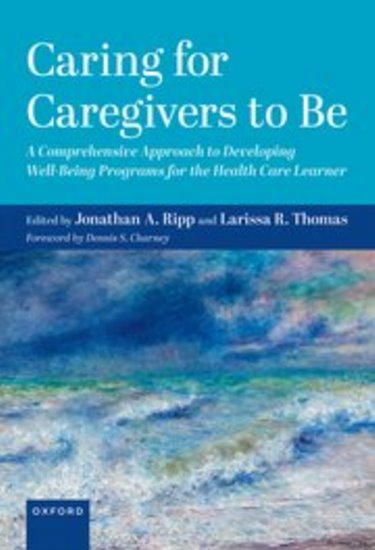
| Caring for Caregivers to Be: A Comprehensive Approach to Developing Well-Being Programs for the Health Care Learner |
|
|
Doody's Core Title (2026 Edition)
|
|
| Score(s): |
|
2.4
(Health Sciences - Medical Education)
|
|
|
ISBN: 978-0-19-765818-5,
388 pages,
Hard Cover
ISBN-10: 0-19-765818-0 |
|
| Copyright: |
2023 |
|
| Edition: |
1st |
|
| Editor: |
Ripp, Jonathan A., MD, MPH; Thomas, Larissa R., MD, MPH |
|
|
Specialties:
|
Medical Education & Informatics |
|
| Publisher: |
Oxford University Press |
|
| List Price: |
$89.95 |
|
| Google: |
|
|
|
|
|
|
|
At A Glance
|
Caring for Caregivers to Be provides evidence-based insights and solutions to reduce burnout and improve well-being among medical learners, particularly students and graduate medical trainees. It provides a scoping review of the research related to the well-being of the health care learner and offers a suite of current and emerging tools and strategies believed to reduce medical burnout and foster resilience. Chapters identify the major drivers of both burnout and flourishing and explore the consequences of sub-optimal well-being for performance and patient care. The volume ends with practical considerations that medical education leaders can use for solutions-based well-being program development and tips for medical learners seeking to improve their own well-being within a professional environment. Caring for Caregivers to Be is the comprehensive guide to promoting the development of a resilient and professionally fulfilled physician workforce.
|
|
Reviewer:
|
Neda Gould,
PhD
(Johns Hopkins University School of Medicine)
|
|
|
Range
|
Question
|
Score
|
| 1-10 |
Are the author's objectives met? |
10 |
| 1-10 |
Rate the worthiness of those objectives. |
10 |
| 1-5 |
Is this written at an appropriate level? |
5 |
| 1-5 |
Is there significant duplication? (1=significant, 5=insignificant) |
4 |
| 1-5 |
Are there significant omissions? (1=significant, 5=insignificant) |
5 |
| 1-5 |
Rate the authority of the authors. |
5 |
| 1-5 |
Are there sufficient illustrations? |
N/A |
| 1-5 |
Rate the pedagogic value of the illustrations. |
N/A |
| 1-5 |
Rate the print quality of the illustrations. |
N/A |
| 1-5 |
Are there sufficient references? |
5 |
| 1-5 |
Rate the currency of the references. |
4 |
| 1-5 |
Rate the pertinence of the references. |
5 |
| 1-5 |
Rate the helpfulness of the index. |
5 |
| 1-5 |
If important in this specialty, rate the physical appearance of the book |
N/A |
| 1-10 |
Is this a worthwhile contribution to the field? |
10 |
| 1-10 |
If this is a 2nd or later edition, is this new edition needed? |
N/A |
|
|
|
Reviewer:
|
Neda Gould,
PhD
(Johns Hopkins University School of Medicine)
|
|
|
Description
|
| The book focuses on the important topic of well-being for medical students and trainees. It begins with a discussion of the broad scope of medical student and trainee burnout and how to develop models and programs of well-being for this population, at both the individual and institutional levels. Finally, it focuses on specific ways to implement these well-being programs. |
|
|
Purpose
|
| The purpose of the book is to provide background on the scope of the burnout problem in medical students and GME trainees and ways to address this issue by designing well-being programs. The objectives are worthy ones given the prevalence and impact of burnout in this population. The book meets the objectives by providing adequate background and specific, concrete examples of creating a well-being program for an institutional culture. |
|
|
Audience
|
| The book is intended primarily for leaders at medical schools. However medical students, trainees, and their mentors could also benefit from reading this book. The book meets the needs of the intended audience. The editors of the book are credible authorities on the subject matter: one is a Chief Wellness Officer at a school of medicine and the other is Director for Well-Being for Graduate Medical Education at another institution. |
|
|
Features
|
| The book provides detailed information on the scope of medical student and trainee burnout, including the various definitions of well-being, different models of well-being, what is emphasized in each, and how to choose and evaluate a model. The chapter on measurement of constructs associated with well-being details the validity of measures and evidence-based instruments and includes a useful chart describing these. The book also includes chapters on the prevalence of burnout and its consequences. Additional relevant and well-written chapters focus on individual- and system-level interventions. The remainder of the book focuses on how to design and implement well-being programs. Particularly beneficial are the "Putting it into Practice" sections at the end of each chapter, which offer practical tips for program development. |
|
|
Assessment
|
| This is an excellent and needed book on this topic. It is useful not only for institutional leaders, but also for trainees and their mentors. This is perhaps the only book in the field that details not only the issue of burnout and importance of well-being, but also how to develop programs for well-being in this specific population. Much of the information can be utilized in other fields as well. |
|
|
|
|
|
|
|
|