eBook/Digital Version available from:
|
 Score: 93 |
 |
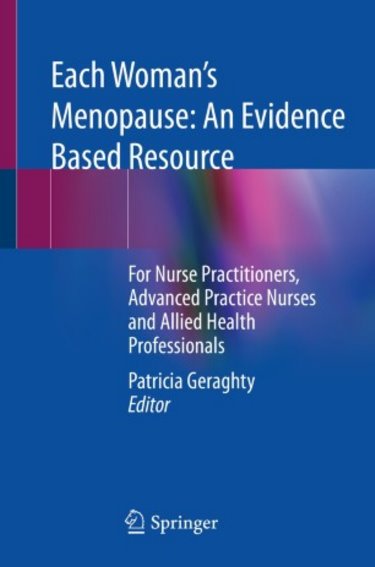
| Each Woman's Menopause: An Evidence Based Resource: For Nurse Practitioners, Advanced Practice Nurses and Allied Health Professionals |
|
|
Doody's Core Title (2026 Edition)
|
|
| Score(s): |
|
2.13
(Nursing - Advanced Practice)
|
|
|
ISBN: 978-3030854836,
413 pages,
Soft Cover
ISBN-10: 3030854833 |
|
|
|
|
| Copyright: |
2022 |
|
| Edition: |
1st |
|
| Editor: |
Geraghty, Patricia |
|
|
Specialties:
|
Advanced Practice
, Maternal/Child |
|
| Publisher: |
Springer |
|
| List Price: |
$99.99 |
|
| Google: |
|
|
|
|
|
At A Glance
|
This book is designed to meet the needs of nurse practitioners, other advanced practice nurses, and allied health professionals working in women's health, primary care, and other specialties. The multiple roles the clinician embraces in menopause management include that of direct caregiver, manager of therapeutics, educator, and interdisciplinary team member or leader. This book provides updated, evidence based information on the menopause transition from the late reproductive stage to post-menopause to optimize the interaction of the clinician and the individual woman in each of those roles. regarding both the menopause transition and the choice of care options are included as critical components of shared therapy decisions. The review of natural menopause physiology and the variability of menopause symptoms are inclusive of diverse women and diverse trajectories. The impact of menopause on chronic disease, sleep, weight and nutrition, mood and cognition, urogenitalhealth and sexuality, as well as vasomotor symptoms are each developed as individual topics by experts in those fields. Evidence based management using hormonal and non-hormonal options, and life-style and other complementary interventions are discussed with the most updated advantages and disadvantages of each treatment option. Consistent with advanced practice nursing theory, the approach is whole patient focused.
|
|
Reviewer:
|
Susan Yount-Tavener,
PhD, CNM(ret), WHNP, FACNM
(Frontier Nursing University)
|
|
|
Range
|
Question
|
Score
|
| 1-10 |
Are the author's objectives met? |
10 |
| 1-10 |
Rate the worthiness of those objectives. |
10 |
| 1-5 |
Is this written at an appropriate level? |
5 |
| 1-5 |
Is there significant duplication? (1=significant, 5=insignificant) |
4 |
| 1-5 |
Are there significant omissions? (1=significant, 5=insignificant) |
5 |
| 1-5 |
Rate the authority of the authors. |
4 |
| 1-5 |
Are there sufficient illustrations? |
5 |
| 1-5 |
Rate the pedagogic value of the illustrations. |
5 |
| 1-5 |
Rate the print quality of the illustrations. |
5 |
| 1-5 |
Are there sufficient references? |
3 |
| 1-5 |
Rate the currency of the references. |
4 |
| 1-5 |
Rate the pertinence of the references. |
4 |
| 1-5 |
Rate the helpfulness of the index. |
5 |
| 1-5 |
If important in this specialty, rate the physical appearance of the book |
N/A |
| 1-10 |
Is this a worthwhile contribution to the field? |
10 |
| 1-10 |
If this is a 2nd or later edition, is this new edition needed? |
N/A |
|
|
|
Reviewer:
|
Susan Yount-Tavener,
PhD, CNM(ret), WHNP, FACNM
(Frontier Nursing University)
|
|
|
Description
|
| This book provides an evidence-based perspective on menopausal symptoms and management of menopause and associated health conditions for all women's healthcare providers. The various stages of the menopausal transition are addressed within the evidence presented. The book provides an appropriate number of algorithms, lists, figures, graphs, and tables to augment the presented information. |
|
|
Purpose
|
| The purpose of this book is to further educate women's healthcare providers on evidence-based management of menopause and related health conditions so they may meet the needs of their clients. Encompassed within the aforementioned goal is the desire to highlight the diversity and uniqueness of each woman receiving care, including proper education via knowledgeable providers so they can make educated decisions. These are worthy objectives that should be crucial to any clinician. The book meets the objectives quite well. The book is needed to add to the tools used to understand and guide women during their menopause journey. |
|
|
Audience
|
| The book is intended for nurse practitioners, advanced practice nurses, and allied health professionals. I would expand the intended audience to all providers who care for women experiencing the stages of menopause. The book was created by a multidisciplinary team to ensure women in various settings and cultures were included. The editor points out the qualitative portions should help clinicians better understand women's lived experiences from the late reproductive through postmenopausal periods. The authors' affiliations are noted but not their credentials, so it is difficult to determine if they are recognized experts. |
|
|
Features
|
| There are two sections of the book. Part I begins with educating the readers with history of the management and menopausal experience for women. Next, women's voices are presented to highlight that women experience a variety of symptoms as they journey through menopause. Communication is covered to share the concepts of cultural competence and cultural humility when interacting with the client. The next chapters cover physiology of menopausal stages and how chronic disease interacts with menopause and menopause hormone therapy. Part II discusses menopausal symptom management of abnormal uterine bleeding, vasomotor symptoms, influence on sleep, mood, and cognition, genitourinary and sexual health, musculoskeletal health, breast health, and nutrition and weight management in midlife. There are summaries provided within the chapters at key areas. I commend the authors and editor on the time and commitment required to provide such great detail in the chapters. The detail walks the readers through each diagnosis etiology and physiology and defines the clinical presentation, statistics, history taking, criteria for diagnosis, evidence-based research, medications/treatment, and/or complementary or alternative medications. The evidence-based research covers all and any aspect found in the literature. This will be extremely valuable to the clinician who values evidence-based medicine and knowing the latest research in one resource such as this book. The evidence presented informs the clinician who can then share with their clientele, augmenting informed decision-making. Clinicians need to be aware when reading the book that evidence does not always have a definitive answer, which this book teaches. Another aspect of many chapters is the discussion of the diagnosis or condition from a socio-cultural, socio-economic, and socio-demographic perspective. Sometimes this is supported with qualitative research in addition to quantitative findings. The organization of the chapters did seem to have a purpose and flow. The tables, figures, graphs, algorithms, and lists add support to the information. They are concise and easy to read. |
|
|
Assessment
|
| This book is very informative and I would recommend it for any provider who cares for women. It expands one's basic knowledge about menopause so providers can fully meet the needs of their clientele. The size of the book and its soft cover make it easy to read, portable, and convenient to have close by when informing women of the research and considering a treatment plan. I did find a repeat of some topics and tables/figures. The repeated information later in the book was more in depth on the topic than in part I, but much of the verbiage was similar. I also found that abbreviations were used a lot throughout the book, though I am not sure if this could have been minimized. Upon initiating reading, I was not certain of the need for the history presented in chapter 1, but I later decided it sets a tone for the entire book. For many, the lived experiences of women presented in chapter 2 may be eye-opening, but that is the intent - to expand knowledge through understanding the client's feelings, experience, and perspective. Chapter 5 presents very good data and succinct summaries. The chapters in part II are impressive and I again commend the authors and editor on gathering and composing chapters on these topics in great detail. This book was more in depth than any other book I have read on menopause in relation to evidence-based care. This book is perfect for the clinician who wants to know it all while having at hand all the evidence-based possibilities for symptoms and treatment, how menopause is experienced, and how menopause interacts with chronic diseases. Updated versions of the book will be needed as more updated evidence becomes available. |
|
|
|
|
 |

|
We regularly update the Doody's Core Titles ® web site when eBook versions, reviews, or information about forthcoming or new editions of titles in DCT. This month we feature:
- 374 new eBooks
- 8 new Reviews (Premium Subscribers Only)
Just Published! Doody's Core Titles® 2026 is available today!
Log in or Order Now to access the full Doody's Core Titles® list.
|
Doody's Core Titles® 2026
Key Features
|
 |
|
A newly selected list of the most distinguished references by subject area |
|
|
eBook Links to eBook aggregators that carry digital versions |
|
|
Free monthly Newsletter about new eBooks, new editions, and valuable industry news |
|
|
Expert recommend-ations of Core Titles and Essential Purchase picks in 120+ specialties |
|
|
Extensive search and filter utilities |
|
|
Easy-to-use export and print tools |
|
|
Click here to read what Collection Development Librarians say about Doody's Core Titles®. |
|
 Sign up for our Free monthly newsletter alerting you to new eBooks and new editions of DCT titles, as well as valuable industry news and insights. DCT Licensees will have a link to all of the features of Doody's Core Titles® from the newsletter. |
|
Interested in sponsorship opportunities for Doody's Core Titles®? Click here to get more information.
|
|